Good Season For Termites
Not everyone will agree, but for termites, it has been a very good season.
Flooding of a year ago and above-average rainfall has boosted soil moisture that is a necessity for termites.
Just this week I opened up a termite mound and found a large number of reproductive termites, some with fully developed wings in readiness for the spring colonizing flight. This is earlier than I expected, even for Queensland, because the flights usually begin in late October through November — and it is still only August.
Serious Termites Basic Habits & Instincts
The serious termites all have the same basic habits and instincts.
Once these ‘teenage’ termites land after their short, warm evening flight, the boy follows a girl in search for their home: wood in damp soil.
They excavate a ‘cave’ beside the wood so they have two of the necessities covered: food and moisture. The third necessity is security; they have to seal their nest site against inquisitive (and hungry) ants by next morning.
If you see hundreds, even thousands of flying insects one warm early summer evening, perhaps after rain, it happens because the termites have judged the outside climate to be similar to that inside the nest. Then the colonizing reproductives will not suffer climate shock, drying out or being too cold to do all the work they need to get through before the ants wake up.
You can easily identify if the ones you see are termites: they shed equal-sized wings about 10-12 mm long.
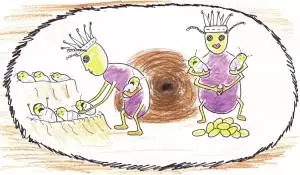
The pair will tend the first batch of eggs themselves, all of which will grow a bit larger in a series of moults, to become workers. These workers take over egg-tending, regurgitating wood to feed the nymphs and the ‘royals’ so the nobs can spend all their time making babies they don’t have to look after.
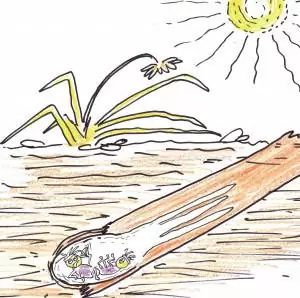
If the soil dries out or if they have chosen a piece of wood that is too small, they will not survive the first critical summer. It takes 3-5 years for a nest to develop into a size that will pose a significant threat to homes and other structures.
Some termite colonies will become a threat even if over 99% don’t.
Because this happens every spring all over Australia, you should take a long term view in defending your home.
By giving termite scouts something easy to find such as 22 TermiTraps placed around your property, you have a great chance of intercepting them before they find a gap through barriers, etc. to the inside of your buildings.
Once inside, you don’t discover what they’ve been eating until a floor gives way, a broom goes through a skirting board or there’s some other failure.
I know I’m biased, but I can’t help wondering why so many homeowners gamble their biggest asset against a small, once-in-a-decade outlay of a few hundred dollars.
Ion Staunton


Thank you as always very interesting reading we try to keep all chemicals to a min.
Regards Gerry
Yes Gerry, even though the chemical that stops termites moulting is not harmful, it stays inside the termite nest once carried back there. Ion
Good stuff Ion, I always read your posts,I found a very large below ground termite nest the other day, and destroyed it, there was a hole about 3 feet deep and about the same across by the time I had finished, with millions of termites, that the chooks and wild birds dined on over a number of days, but I have found live termites since then, I don’t know if they are left over from the nest I destroyed, or are they from another colony
The birds and chooks will love you and lay great eggs for you forever!
Yes there will be some perplexed and puzzled stragglers coming back from the food sources to where the nest once was. If there are no more found after another week or two then ‘stragglers’ is the diagnosis. If you keep finding termites (say in the leaf litter or mulch) after this next couple of weeks, the probability is another nest somewhere. Can I assume you have checked any hollow trees? — Always prime suspects.
Ion