A House is like Dead Trees & Fallen Logs to White Ants and Termites
If you were a termite with acquired instincts built-in after eons of seeking and finding wood, you could easily settle for timber wrapped inside masonry and plasterboard if that’s the only wood you can find.
White ants and termites simply eat houses because they mistake them for dead trees or fallen logs.
Survival of the species over millennia indicates they’ve learned the essentials: shelter, food and moisture — and how to find them.
The subterranean termites (the main type that does over a billion dollars in damage each year to Aussie houses) build their nest in the soil, inside a hollow tree or a mound sitting in the soil. This gives them a constant source of moisture; they also need to be within reach of something cellulose, the main ingredient in wood but it’s also in paper, cardboard, cotton, linen, etc.
Termites finding food is their constant challenge.
In those prehistoric times, a log under attack might easily be washed away in a flash flood — or burnt. Gone! Small pieces of wood are totally consumed. Gone! This means another food source is needed to keep the ever-hungry nymphs and royals back at the nest in a manner to which they have become accustomed. And, what is better than a backup food supply? Several back up sources. Seeking and finding additional food in different directions is another acquired survival instinct.
But, termite and white ants are eyeless and have a thin body shell that quickly loses moisture in dry conditions; it’s a perfectly efficient body design for inside a dark, climate-controlled nest with thick mud walls, but it presents heightened vulnerability outside.
How do Termites find their food?
Entomologists are still working on answers to that.
There is more than one way and there are many triggers and incentives that lead termites on their missions. Timber below soil level is often found by bumping into it. The weight of big numbers searching helps the success rate, but this is an inefficient use of labour and time even if there is plenty of both.
Timber in damp soil begins to decay and the decomposition gas includes carbon dioxide which spreads through the surrounding soil and entices termites \ white ants to move upstream toward the source. Bingo! Some pest technicians add a sprinkle of a sports drink into the monitors they bury in the ground around buildings. This could be a throwback to the anecdotal old wives’ tales of decades ago or there could be a little ‘extra something’ from the sugars (chemically related to cellulose) in it.
How do they find timber with no soil contact? Such as your house? Or a cardboard box of books or tax papers sitting on the garage floor, or a timber shelf in your metal shed? When you think about it, the prehistoric food sources were mostly above ground; logs and fallen branches lay on the forest floor. Today our houses are set on concrete foundations with no timber (these days) in contact with the soil. Yet they find their way in. All the TV program’s you see of termite \ white ant damage in houses is the result of the exploratory genius (and persistence) of scouts coming up out of the soil across whatever barriers were there to get, unnoticed, into the timber they’ve found.
How did they find it?
Because scouts, blind as they are, go out ‘looking’ above the ground and out in the open, usually under the cover of darkness. They may be homing in on something emanating from timber: secretions and other trace agents; the smell of resins?
The series of photos shows one way and an associated reason why white ants find access into modern townhouses
Building Standards require physical barriers and in most instances, chemical barriers to be applied at appropriate stages during construction.
The concrete slab itself is a barrier. It seldom cracks if the steel reinforcing is correctly in place.
Cracks of less than 2.5mm are too narrow to allow the passage of termites or white ants.
Other physical barriers are used to prevent access beside the utility cables and pipes, so by rights, the only way termites can get to timber is over the edge of the slab.
And, that’s what usually happens.
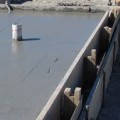
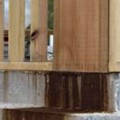
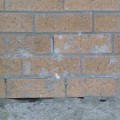
If any of the gaps go all the way through, the termites have a stained map of the highway to heaven — or hell if you are the owner.
This is why termite monitors, while not a barrier, become a highly successful interception device.
Any homeowner can place, check and, when termites \ white ants find monitors add Colony Killer Termite Bait for them to take back to kill off their colony.
Why would termites want to enter a TermiTrap?
Because they are placed on the surfaces of the garden, gravel pathways, over the cracks between pavers and over the expansion joints of concrete paths, aprons, shed slabs, etc.
Being open at the bottom, secretions from the timber inside is washed out and down the cracks when the TermiTraps are wetted with rain or an occasional hosing down.
If you place plenty of them around and you look at the open holes as you walk past, chances are high that if there is a nearby colony following their natural scouting instinct, they will find one.
When they do, another natural instinct kicks in: to enclose and climate control their feeding area and make it their own by closing up the top hole with a mud mixture.
Thats your signal to add the Colony Killer Termite Bait which kills white ant and termite colonies but is safe for people, pets and wildlife.
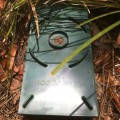
Hole open or closed?
It’s not hard to pick the difference

Termite Prevention
The TermiTrap monitor uses termites instincts against them; it entices them into a space full of food they like, space is enclosed enough to make it easy for them to finish the enclosure just by sealing the hole, a signal easily noticed in a passing glance, and, when you add Colony Killer Termite Bait which is easier for them to harvest than having to chew off wood, again they do what comes naturally and termites take the preferred bait back to kill off their colony. How to kill Termites
Resetting the monitors means it can happen again and again, anytime termites or white ants from developing colonies come snooping around over the next couple of decades until the UV protected polypropylene box finally gives up in the sun.
Termite instincts are powerful.
The design of the TermiTrap has harnessed these instincts for use against them. You are actually helping termites and white ants self destruct.